Dual-Use Technology Boom Is Changing Perceptions of Defence and Security Investment
7 min readCANADIAN INVESTMENTS REVIEW & BENEFITS CANADA • SEPTEMBER 23, 2026
This article was originally published by Canadian Investment Review and Benefits Canada on September 23, 2026.
There’s much more to defence and security investment than planes, submarines and weaponry, if you ask Ash Lawrence.
“There's an entire part of the market that isn't battlefield oriented,” says Lawrence, the head of multi-boutique alternatives business AGF Capital Partners, explaining that an ever-growing pool of investors are moving on from the more traditional view of the sector.
“This evolution doesn’t just relate to what is being deployed, but the technology embedded in it,” Lawrence adds.
Earlier this year, Prime Minister Mark Carney put dual-use technology – products with both defence and commercial applications – at the heart of his Defence Industrial Strategy, which promises to boost Canada defence spending to 5 per cent of GDP by 2035.
For industry insiders like Glenn Cowan, managing director and head of defence and security investing at Kensington Capital Partners, and the founder of ONE9, Kensington’s defence and security investment platform, the concept of the military as an early investor and innovator in dual-use technology is not a new one.
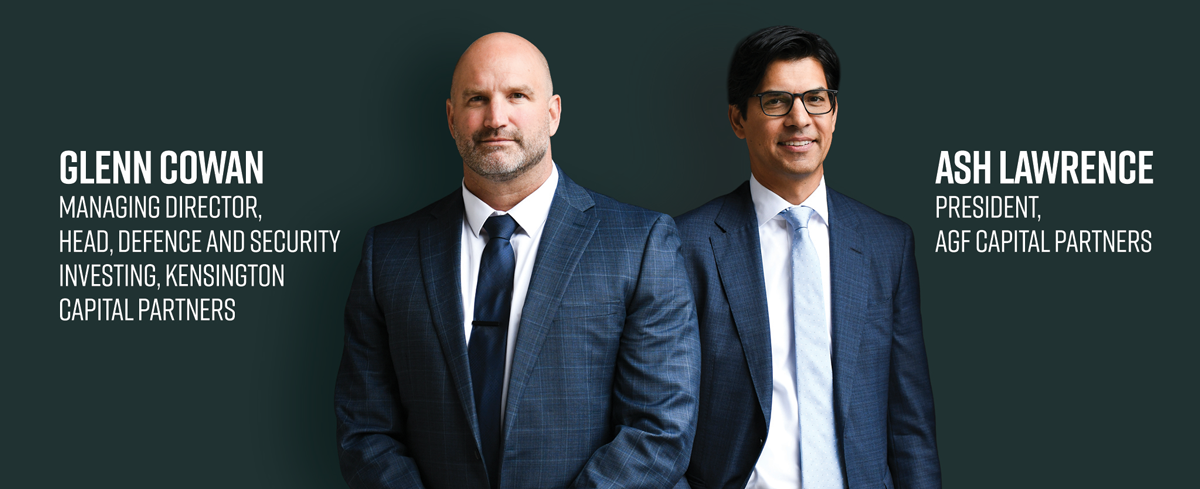
In fact, he had a front-line view of developments during his 19-year career as an office in the Canadian Armed Forces in which 14 years with a Canadian Special Operations Forces Special Mission Unit that conducts some of the Canadian Armed Forces’ highest risk counterterrorism and national security missions.
“There’s no better place than your top special forces unit to develop, deploy and validate all the cutting-edge technologies that lead to mission success,” Cowan says.
He founded ONE9 as a personal investment vehicle while still serving with the CAF, before pivoting to defence and security venture capital investment full-time a decade ago. In 2019, AGF Capital Partners’ affiliate Kensington acquired ONE9.
“When no other institutional investor in the country wanted to touch defence, Kensington anchored our first closed-end fund. And we've been partnered and co-investing now for seven years,” Cowan says. “We saw the writing on the wall for this massive defence pivot a couple of years ahead of the market.”
Dual-use technology has been a heavy focus of ONE9’s investments, with a focus on emerging disruptive technologies linked to cybersecurity and counter-unmanned aircraft systems.
“We like to really understand how to safely and securely protect critical infrastructure from some of the new types of threats that we're experiencing,” Cowan says.
In the coming years, he expects further investments in companies whose innovations relate to aerospace and artificial-intelligence powered robotics. However, Cowan also encourages portfolio companies to think outside the box when looking for potential commercial uses of their tech.
“Other than a kinetically offensive weapon, almost every piece of technology has applicability outside of the military,” he explains. “A defence enterprise is a massive organization with many significant capabilities. Everything from human resources software to predictive maintenance analysis is going to be just as important and applicable to a large oil company, for example.”
The dual-use technology sector is primed for even further growth in the near future, according to Lawrence, due to a steady rise in geopolitical instability in Europe the Middle East. He sees Canada’s recent defence spending promise – roughly quadrupling the annualized defence budget to around $150 billion – as the culmination of a longer-term structural shift.
“We are seeing a more fragmented, security-oriented world, where sovereignty really matters – and not just in Canada,” Lawrence says. “NATO countries are looking at their sovereign capabilities and realizing they can’t rely as much on others' capabilities, so they’re developing what they need within their own borders.”
“This is a secular change, not a cyclical one,” Lawrence adds.
While rhetorical commitments to the defence sector are nothing new, governments around the world are backing up their words with solid action this time.
“It's not just government spending directly, but it's also indirect support for private capital to be invested in the sector. The policies that government is discussing, and in some cases already putting in place, are facilitating and speeding up the integration of private capital into the space. That makes this sector much more attractive to invest in,” Lawrence says.
Any lingering doubts about the Canadian federal government’s commitment to defence and security investment were dispelled this summer as large deals began flowing, including the announcements of German shipbuilder Thyssenkrupp Marine Systems as the preferred supplier for Canada’s new submarine fleet and Saab’s Global Eye as the preferred solution for the nation’s Airborne Early Warning and Control capability.
But it’s not just big-ticket items that are getting the go-ahead as the government’s “open-for-business” message trickles down through the ranks of the military, according to Cowan.
“We're starting to see spending authorities becoming more decentralized, which is going to increase the speed at which some of this capital can get in market,” he says. “Demand is surging for private capital, and in particular venture capital, which is an asset class with the speed, agility and openness to deploy and back this sort of emerging technology.”
Firm government backing has also helped the industry shed some of the reputational stigma that traditionally attaches itself to defence investments, paving the way for family office and institutional investors to act on the opportunities they see in the field, Cowan adds.
“It has helped open the door for them to come in and back a sector that might have been a little taboo in the past,” he says.
Still, as investors begin to flood the zone, Lawrence says they should be wary of managers jumping on the defence and security investment trend. He recommends they partner with organizations that have the specialized investment expertise to match their scale and organizational resources.
Without the guidance of ONE9 and Cowan’s deep connections to the Canadian military and broader defence industry, Lawrence admits he would have been hesitant for AGF Capital Partners to participate in defence and security investments.
“There is a broader understanding of the defence complex and how it operates that you have to take and merge with the technology knowledge that a lot of venture firms have,” he says. “If you have one without the other, it’s going to be difficult to perform and achieve investment objectives in this space.”
Cowan says the strength of his team at ONE9 and the access they can achieve based on connections made during long military careers are what sets his firm apart.
“You can’t just walk up to a top special forces unit or intelligence agency and ask them what’s keeping them up at night or where are their technological gaps,” he says. “Because of deep relationships formed over decades, we are able to ask those questions and have those conversations.”
Earlier this year, Cowan himself travelled to the Russian border, embedded with NATO’s Canadian-led Multinational Brigade in Latvia, which is currently this country’s largest military deployment. Other ONE9 team members are on the ground in current and potential future global hotspots such as Ukraine and the Arctic.
Another ONE9 director has a legal background, having spent more than a decade advising commanders on targeting operations and policy issues as a member of the Office of the Judge Advocate General.
“To invest responsibly in defence, it’s really important that we get into the legality, ethics and morality of using certain technologies,” Cowan says. “We’ve built our team around this and combine it with the broader support of AGF Capital Partners, to offer allocators a generational investment opportunity in defence and security investing.”
Disclosure
This information is provided for educational and informational purposes only. It is not intended to address the needs, circumstances, and objectives of any specific investor. The content of this publication is not to be used or construed as investment advice, as an offer to buy or sell any securities, and is not intended to suggest taking or refraining from any course of action. Every effort has been made to ensure accuracy in these commentaries at the time of publication, however, accuracy cannot be guaranteed. Market conditions may change and AGF Management Limited, its subsidiaries and affiliates accept no responsibility for individual investment decisions arising from the use or reliance on the information contained herein. Investors are advised to consult with a professional advisor prior to making investment decisions. This document may contain forward-looking information that reflects current expectations or forecasts of future events. Forward-looking information is inherently subject to, among other things, risks, uncertainties and assumptions that could cause actual results to differ materially from those expressed herein.